Showing posts with label WWII. Show all posts

Tuesday, June 28, 2011

Stockings on the ration.

Sooooo I started this post about two weeks ago. 13 days ago if you want to get technical, but you know... I'm like that. My brain got sidetracked as it tends to do and I did things like paint and stuff.

Anywho today let us touch on my most favorite subject of subjects: Underpinnings. Specifically stockings. More specifically I want to talk about stockings on the ration; a subject that I've always found incredibly fascinating. No matter what was going on a fashionable lady in the 1940s still just had to have her legs covered.

I tried to think of something to equate this trend to in today's terms, but nothing came to me. The best I've got is today's requirement for toe nail polish with open toed shoes, but even that example doesn't really cut the mustard. Stockings had more to do with propriety. We were wearing shorter skirts and starting to lose the corsets and girdles, but stockings were still something that you just wore. According to my grandmother you found a way to get stockings during this time even if you didn't have much money for anything else. It was just something you did.

Woman wearing stockings in the 1940s
I still think all ladies should be wearing stockings, but that's just because nothing looks better to me than a lady's finely stocking-clad leg. (sidenote: Not being sexist, Dudes, but few men were wearing stockings back in the day. If you want to wear stockings today though I say go for it! It's 2011 baby!)


1933 Advertisement for Silk Chiffon Stockings. 
So rationing. Silk stockings were first rationed in the united states in 1941 due to deteriorating trade relations with Japan who had been our leading source of silk. Silk stocking production came to a halt. This meant that the stockings still available in the US quickly became very much unavailable. When the US did finally enter the war the military immediately began collecting used silk stockings to re-purpose into essential military supplies.  Parachute material comes to mind first, but it was also made into other war time items such as barrage balloons and powder balloons for navel guns. Apparently escape maps were sometimes printed on silk as well though I don't think that was taking up much of the supply.

Woman donated their damaged silk stockings in droves. A great show of patriotism says I! Those stockings that were undamaged were often reserved for very special occasions like Christmas or formal events and they were treated with great care.


The solution to the stocking shortage for most women was a switch to nylon, cotton or rayon stockings. (Though nylon became unavailable in 1942 when the War Production Board took DuPoint's complete nylon supply for the war effort.)

Ann Sheridan Shows off her cotton stockings during wartime.
Cotton and rayon stockings were not the complete solution however. The main problem with these types of stockings were that they didn't fit well and tended to sag around the knees and ankles. I've worn a pair of rayon stockings and I can attest to this. They also tended to be much thicker and therefore considerably less attractive.

Another popular solution was for ladies to literally paint the stockings onto their legs using oil based liquid makeup (typically MAC). They would then have a friend apply the back seam with eyeliner. Apparently the stockings could last for up to three days if the woman didn't bath or get caught in the rain. One also had to be careful when crossing one's legs as they could rub off.

Women painting stockings and back seams on legs. 
Interesting self seam application tool. Not totally sure why she needs to be standing on a stool for this, but you know. 
Another really interesting option particularly for women in the UK where makeup was far less available or for women who just couldn't afford the amount of makeup necessary was Gravy Stockings. Yes, you read that right. Gravy stockings. The technique was pretty simple. Boil down bones and left over bits of meat from dinner into a thick dark colored gravy and then paint away!


Here's a cute little video from a British show called horrible histories demonstrating this process (with a little less care than a lady would have used at the time.)


See you later, Alligators!

Tuesday, May 11, 2010

Vinspiration Tuesday: The Photography of Alfred T. Palmer Women at Work

Must apologise for being a bad blogger. My Beau and I went to Six Flags Over Georgia this weekend to ride some of the rollercoasters. Secret confession time: Nancy is a roller coaster fiend. The lines were short for most of the day so we rode a lot of coasters (including some very old very bumpy coasters). It was a whole lot of fun, but my back has been hurting ever since. So I've been slathering it with an herbal remedy and recovering. No sewing has been going on since Sunday because my sewing spot is on the floor, but I did work a little on some knitting while I leaned up against the heating pad on the sofa yesterday.


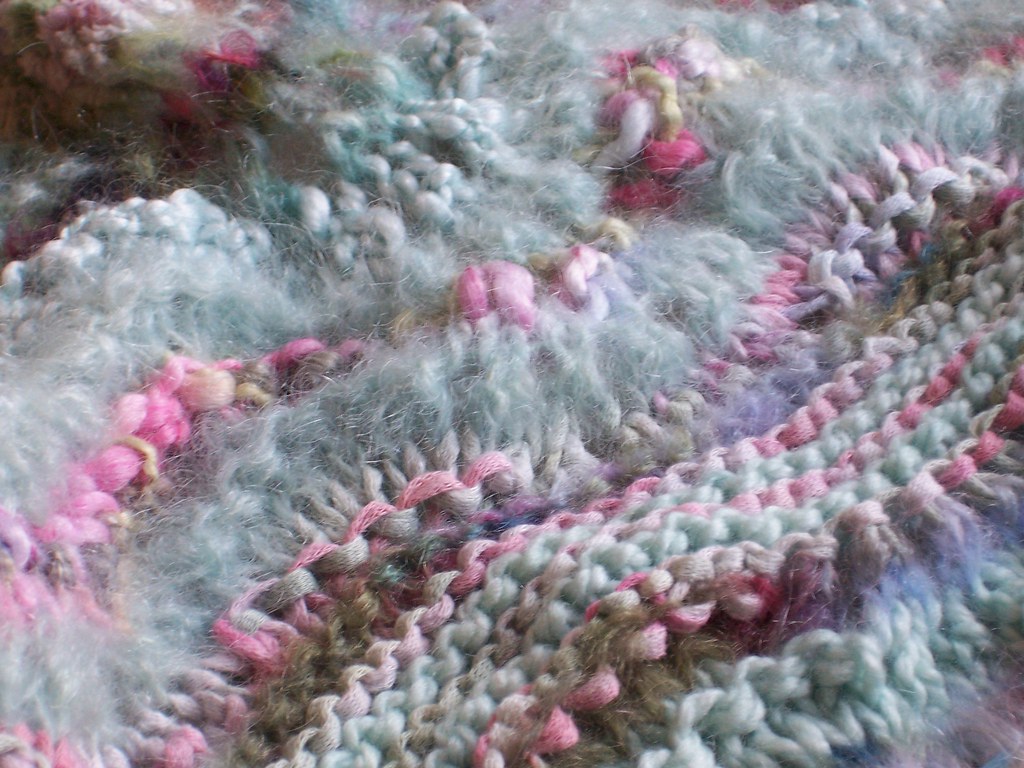
I've been working on the Absolutely Fabulous throw from Colinette Yarns. If you haven't checked them out, their colors are phenomenal. The above image shows my throw in the color scheme "water lilies" and it really doesn't do the colors justice. They're much prettier in person, but this was the best my junky little camera could do today.


With that out of the way- Onto more vinspirational photos! Today the photography of Alfred T. Palmer from the Library of Congress. Women at work. I'm going to try to pick color images if I can for these Vinspiration segments. First of all it's extremely fascinating to see the colors worn at the time, what colors were actually popular and what not. Second it's so interesting to see an era that is almost always shown in black & white in full color. There are lots color prints from this time (believe it or not) and we should definitely embrace them!


Now a quick little history lesson about these prints since I choose a bunch from one set. All these photos were taken by Palmer while he was employed by the Office of War Information (OWI). During this time Alfred Palmer captured literally thousands of photographs. These photos were published in the major magazines and newspapers of the time in the United States and abroad. According to alfredtpalmer.com "His works were praised for their exceptional symbolic power and striking use of intense contrasts conveying the courage and determination that Roosevelt sought to arouse in the nation." So there you go. Time for some cute vintage 'doos and outfits! 


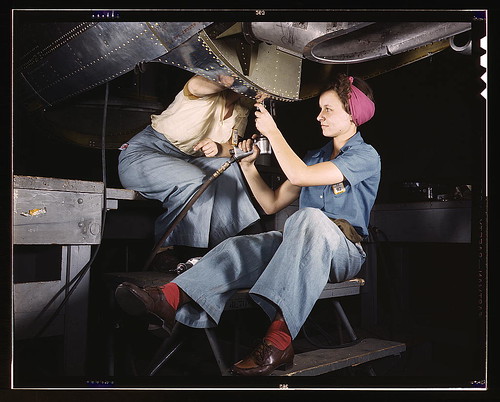
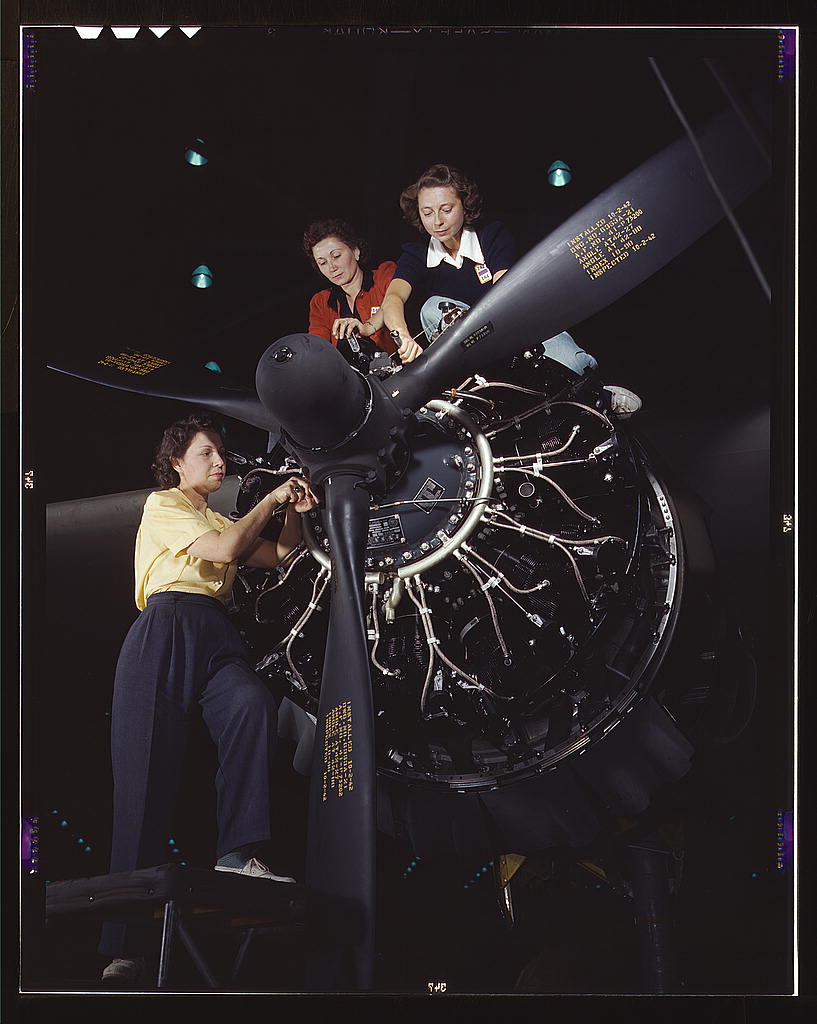
Women at work on bomber, Douglas Aircraft Company, Long Beach, Calif. 1942 Oct. For this image I think I am most interested in the way the lady in front wraps her hair with her scarf. Actually there are lots of interesting ladies with scarf wraps in this series. I tried to get a wide variety of photos so I think this is the only one I chose with a scarf over her hair. I like her masculine shoes and wide legged blue jeans. Makes me a little nervous seeing her working in a place like this in shoes like that. Where are her steel toes? This is one of the more masculine looking ladies in this photo series. She's not wearing lipstick or nailpolish like most of them so I have to believe this is pretty close to what women were actually wearing while working in factories. I don't believe those are men's jeans, but it's hard to tell. I can't find solid evidence of a side closure or a fly. The lady in the back is definitely wearing lady's bluejeans as evidenced by the cut around the waist so I'm going to say our lady in front is more than likely wearing woman's cut jeans.


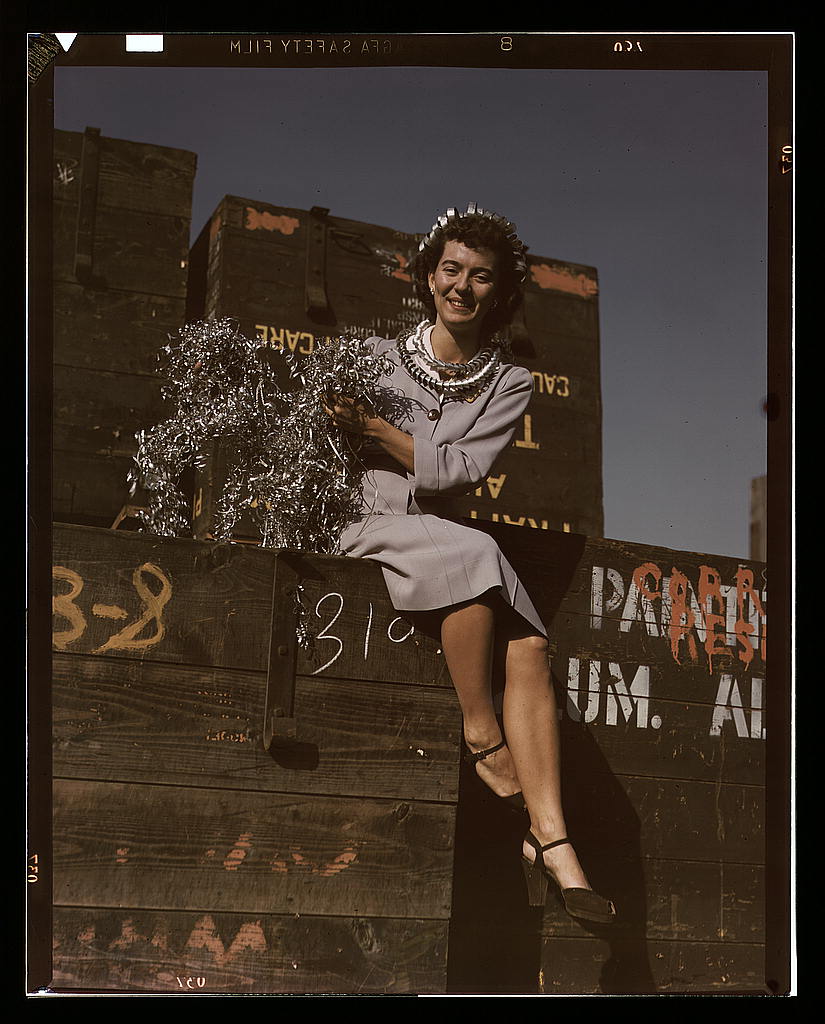
Annette del Sur publicizing salvage campaign in yard of Douglas Aircraft Company, Long Beach, Calif. 1942 Oct.  This is the only lady in the series who is named. I'm most interested by her shoes. I think I owned those shoes or something very similiar in Jr. High. I love love love her suit set. The cut is very nice and the color is a wonderful soft gray. The collar is a little difficult to see, but it is a nice cut. She is not wearing stockings which I wonder about. At the time stockings were being made out of rayon so I don't think her lack thereof is because of rationing. Not all ladies wore stockings, but it is unusual to see that in print ads like this. Especially with a suit set. Her crown and necklace are made of recycled air craft parts.


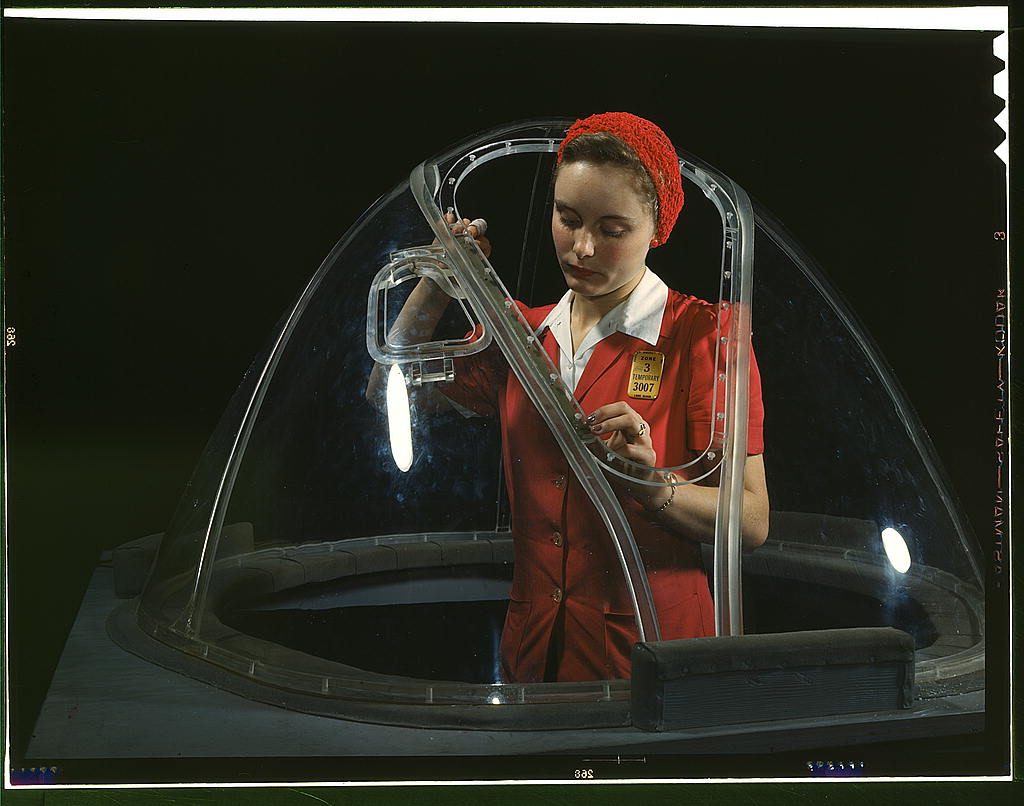
This girl in a glass house is putting finishing touches on the bombardier nose section of a B-17F navy bomber, Long Beach, Calif. She's one of many capable women workers in the Douglas Aircraft Company plant. Better known as the "Flying Fortress," the B-17F is a later model of the B-17 which distinguished itself in action in the South Pacific, over Germany and elsewhere. It is a long range, high altitude heavy bomber, with a crew of seven to nine men, and with armament sufficient to defend itself on daylight missions. 1942 Oct. I like her matching red snood. Look how her nails are painted and she's wearing a wedding band.  She is also looking very dapper in her blouse and jacket set. Seems a little out of place for this type of work don't you think? More like something one would wear to walk down to the butcher or grocery store. I have doubts that she wore this type of outfit every day to this job.


Women at work on C-47 Douglas cargo transport, Douglas Aircraft Company, Long Beach, Calif. 1942 Oct. Whether or not these women actually wore their hair so perfectly done to work and not just to this photoshoot I find it fasinating that they've chosen to show most of the women workers as feminine. "I'm doing a man's work, but I'm doing it with class and style" as opposed to the Rosie the Riveter look from the first image I showed you.  And for all those people who don't believe that woman wore slacks pre-1960s here's the proof. No fly. These girls do not have their hair covered, but I would guess that's more to do with the photoshoot. You wouldn't catch me working on one of those things with my hair flying every which way. Again no steel toed boots. This is pre-OSHA after all.


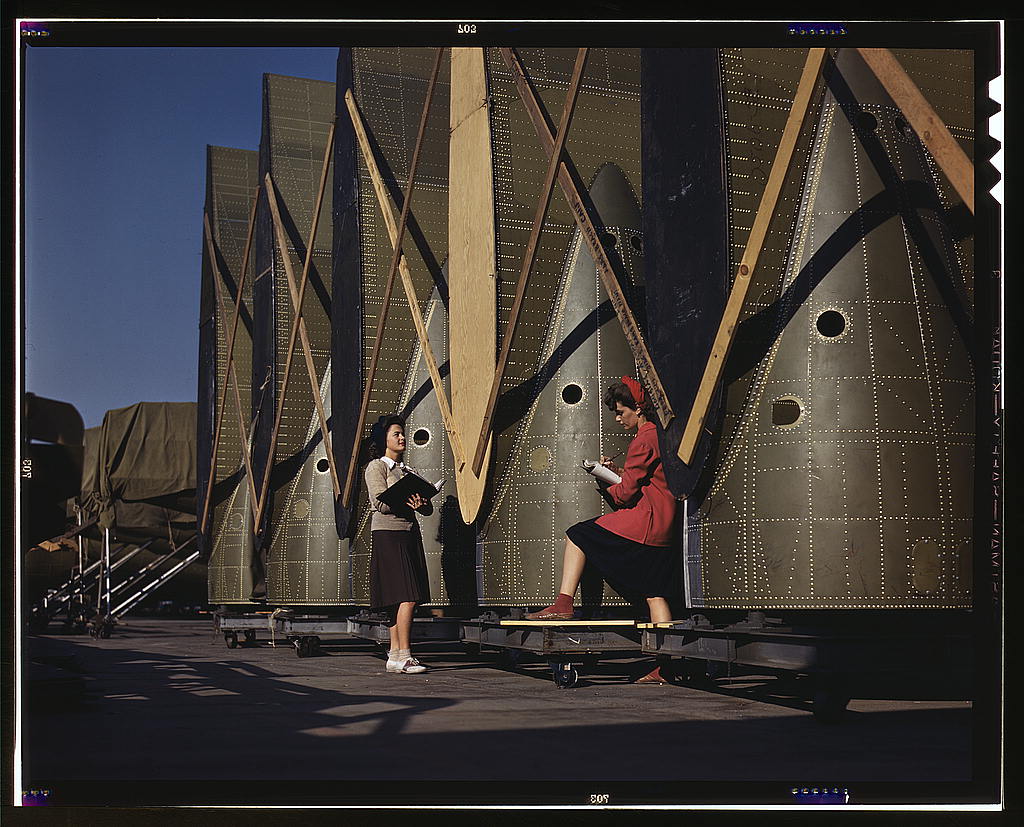
Carefully trained women inspectors check and inspect cargo transport innerwings before they are assembled on the fuselage, Douglas Aircraft Company, Long Beach, Calif. 1942 Oct. And here we come to the more white collar type jobs. These ladies are inspectors so they are wearing skirts as opposed to slacks. They probably have to do a lot of walking as both are wearing flat soled shoes. One lady has the cutest pair of saddle shoes. Love those.


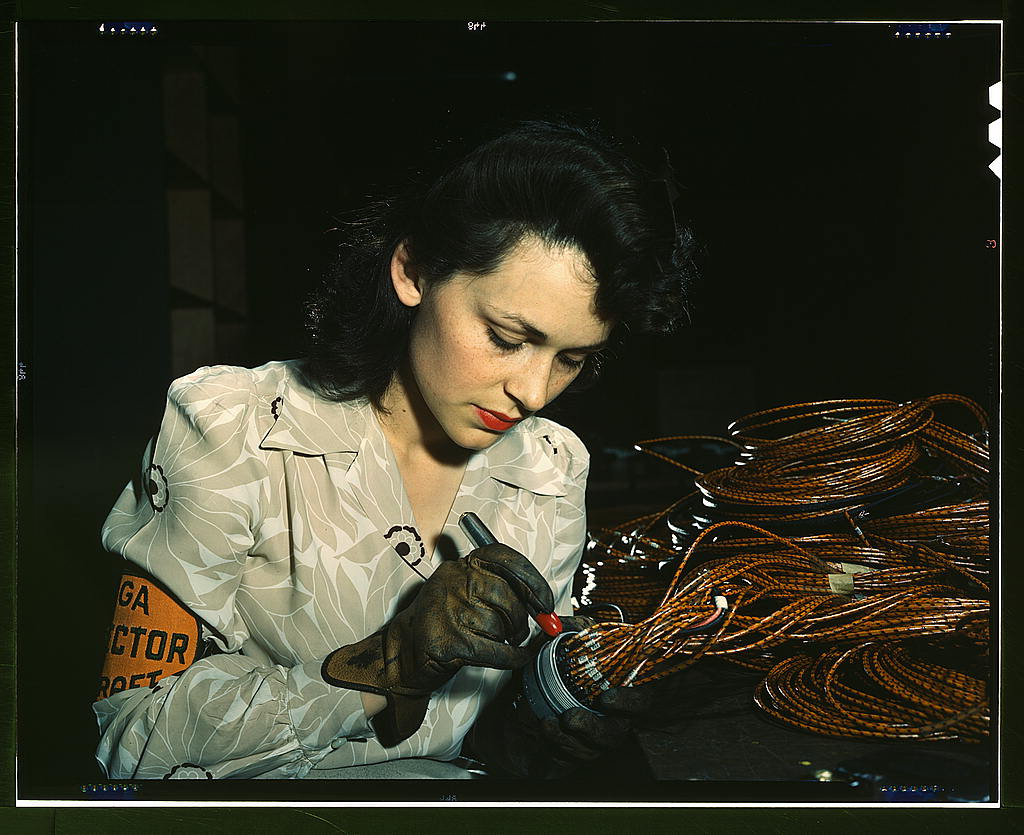
Woman aircraft worker, Vega Aircraft Corporation, Burbank, Calif. Shown checking electrical assemblies. 1942 June. Here we have another of the more white collar work ladies. She's an electrical inspector of some sort. Love the print on her blouse here. Wish I could find something like this for a frock of my own. I love how they put her oil stained gloves on her for this photo. As if that gorgous blouse would stay clean in this type of place. If she did wear this type of outfit to work regularly I can guarantee she had a smock of some sort that she wore over it. There are a lot of great smock patterns for work and home from the 1940s. I know there are some great ones like Advanced 4137 on the Vintage Pattern Wiki.


A noontime rest for a full-fledged assembly worker at the Long Beach, Calif., plant of Douglas Aircraft Company. Nacelle parts for a heavy bomber form the background. 1942 Oct. I saved this image for last since it's my favorite. I'm absolutely in love with her cute little loafers, her red vest, broach, snood and slacks. Not quite sure what her job is since it's not mentioned other than "assembly worker", but she is just darling. I don't really wear slacks, but if I did I would be making this outfit right now.