Showing posts with label 1910s. Show all posts

Friday, July 22, 2011

A Brief History of Men's Shirts from 1900-1949

Something I've always been interested in as you know is the evolution of clothing. I'm always curious to know things like how this:
approximately 1840
Turned into this in a period of 20 years:
1860

Now granted men's fashion has changed a bit more slowly than women's fashion in the past few centuries, but we can all agree that it has still evolved fairly quickly.

1810
1910
2010
(Nancy note: This girl lived the next town over from me and went to my rival high school at the same time as me. She was even on our rival cheerleading squad. Please don't think any less of me...I promise no one else from that area talks like her.)
But all joking aside I could write a book on how men's fashion has changed in this century alone, but what I'd like to do today is talk about how a man's everyday shirt has changed since the beginning of the last century.

1900s:
Ca. 1900s (1907ish)
Here's an example of a pretty typical late 1900s shirt. There is a high detachable wing collar (rounded) and two cuff options. The sleeve plackets are pointed and the yolk is straight. This is what is called a "coat shirt" because if the fact that it opens all the way down to the bottom and can be slipped on like a coat.


The type of work shirt you wore, like today, depended on what you did for a living. Business men typically wore suits and white shirts of finer material while day laborers wore more colored shirts of much sturdier fabric (color hides stains and dirt). A man had many shirt patterns and colors available. Polka dots, double stripes and single stripes were popular as well as the traditional white.

Both acceptable shirting fabrics. 

Collars came in detachable variations like the shirt pictured above and rarely softer attached collars. In the early 1900s collars were much more popular as they increased the longevity of the shirt. Shirts were still yet to be mass produced and a gentleman typically had less than a weeks worth of shirts in his possession at any given time. You will also note above that the collar is quite high. This is left over from the late Victorian era, but as we approached the end of the decade shirt collars start to shrink in height.

1910s:

 late teens (source)
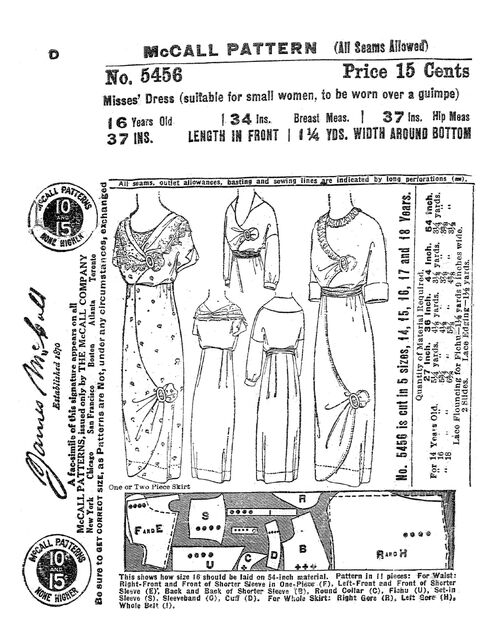
So this is a Negligee shirt or what I would call a semidress or casual shirt. It is not a night shirt. That's something completely different. (Nancy note: the term negligee doesn't become associated with bedroom attire until 1930s.) This shirt also has a detachable collar option and what's called a front-plait opening down the front. The placket ends a little more than midway down the shirt and the shirt is meant to be slipped over the head, though the pattern does give you the option to make it a coat shirt. The neckline is still quite high, but lower than the previous shirt. The rounded collar was still the more popular style at this time, but it would be going out of fashion shortly.

There are two versions of the shirt pictured above. The far left is the negligee version, the center collarless version is what's called an outing shirt. This shirt could also be considered a work shirt if it was made with a sturdier fabric. The type of shirt at this time was determined mostly by the fabric used. Lighter fabrics for casual wear, slightly heavier fabrics for casual wear, and sturdier still for work shirts. The pointed yolk was typically found on casual shirts like these, but on occasion it would pop up in more formal wear.

From a Guild to Making Shirts reprinted 1928 

Many colors were still popular at this time. Stripes, half stripes, and even on occasion checked fabrics were worn.

1920s:
Early 1920s
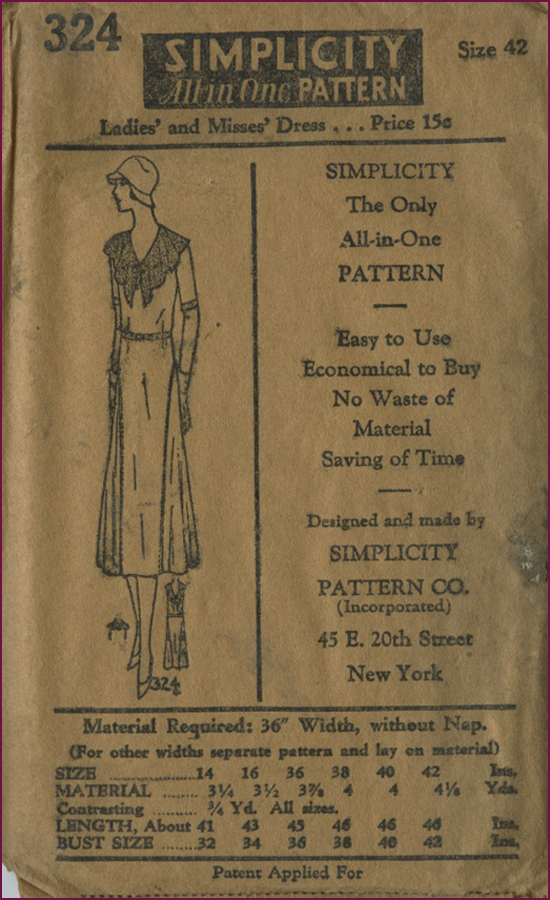
This shirt features a slightly more modern look. You still have the option for a detachable collar, but the main image of this pattern shows a pointed attached collar. Even the detachable collar is slightly pointed. The shirt again gives you the option of coat shirt style opening or front-plait style opening. There are two cuff options including a detachable reversible soft cuff.

During the 1920s the silhouette of the shirt begins to change due in part to improved manufacturing techniques. Shirts become more fitted, with straight fitted sleeves. French cuffs are the norm. Pointed soft attached collars become more and more widespread thanks to the invention of the home washing machine. Rounded detachable collars are still popular among the older population, but for the trendy folks pointed collars become the normal shirt for business wear. They were secured with collar studs or pins and a tie. Detachable collars are still popular among day laborers for their ease of care and increased shirt life.

1930s:

source
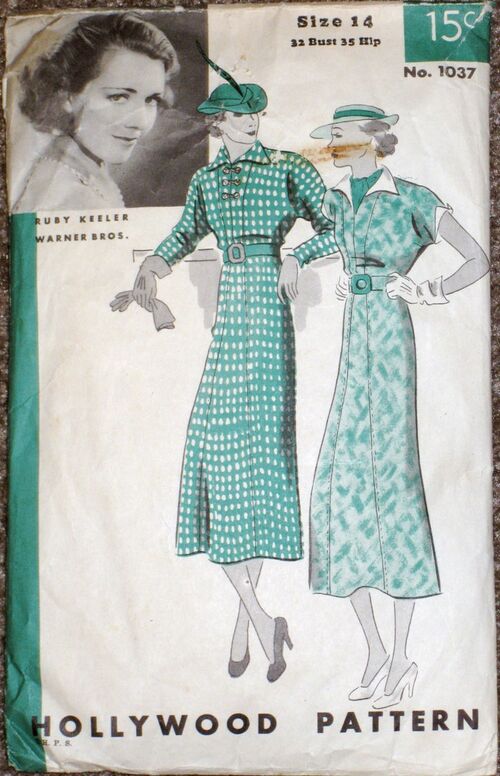
Now we're cooking with gas, as they say. This is really starting to look like today's men's shirt. This pattern only gives the option of the coat shirt opening. Plait-front shirts are pretty much obsolete. The placket still ends quite high on the shirt, but this is in accordance with the pants style of the 30s in which a high waist was preferred.

French cuffs, pointed sleeve plackets, and a longer shirt collar point are all features of this particular shirt. Also popular at this time. Collar stays!


Which were really more like tie clips, but still amazingly effective. Clip stay to tie and each side of collar and voila! Collar stays put all day long. Genus says I.

1940s:

The 1940s bring with it an explosion of different styles of shirts. Shirts become more and more casual. Short sleeve shirts are very stylist for casual wear, sport wear and even work wear.


Fabric choices explode. Flannel, cottons, rayon, prints, prints, prints, and more prints all become popular for work and casual wear.


Western shirts become popular in the late 30s and into the early 40s. This is caused the increased popularity of western movies and stars like John Mack Brown, Red Berry, Harry Carry, Jr. and more. I have a secret love for these, but Mr. Fiance has promised me he will never wear one. Bummer. 


The button down business shirts stay about the same. Detachable collars disappear and the softer pointed collar firmly cements its place in men's fashion. Shirt tails become shorter and plackets extend as the waist on men's pants lowers.

And that, my lovely friends, is that. If you found this helpful drop a comment in the comment section below. Next post: 1950s-1960s.


If anyone was confused by some of the terms I used in the post here's a helpful diagram.

source


Additional References and Some Good Supplemental Reading Recommendations:

Friday, July 1, 2011

Vintage 4th of July recipes and a crochet pattern.


It's almost the forth of July which means that we can all look forward to a day off from work (if you live in the USA and your office actually gives you the day off). It's a day to spend time with friends and family and to eat delicious food. In celebration of one of the more fun holidays of the year (in my humble opinion) I busted out a bunch of my old cook books, personal recipes, and craft magazines to find some old school summer picnic fare. Some are a little odd, but some are pretty good. If you happen to try any of these recipes drop a comment and let me know what you thought of them.

Pear and Banana Salad
From the Workbasket July 1953 edition. 
For each serving arrange 2 pear halves on salad greens, one with cut side up, the other with cut side down. Peel banana, run tines of fork lightly down sides. Cut into 1/4 inch thick slices and arrange in half circle over-lapping slices in front of the pear halves. Garnish pear with a cherry or other berry and serve with a tart or sweet dressing.

Sweet Dill Pickles
From the Workbasket July 1953 edition.
- One Quart Dill Pickles purchased in store
- 2 cups sugar
- 1/2 cup terragon vinegar
- 1 tsp celery seed
- 1 tsp mustard seed
Wash and drain cucumbers, cut into chunks. Mix all other ingredients together and bring to a boil, remove from fire, let cool, and pour over chunked pickles. (Nancy note: This sounds awesome, though so not on the Bomber Girl diet plan... alas, maybe next year.)

Cherry Coke Salad
Date unknown, recipe from private collection originally obtained from Charming Vintage Recipes. 
- 1 package of cherry or black raspberry jello
- 2 cups water
- 1 12oz coke
- 1/4 cup cold water
- 1 #2 can crushed pineapple
- 1 #2 can bing cherries (Nancy note: #2 cans = 20oz)
- 2 small packages cream cheese (Nancy note: small package = 3oz)
- walnuts
Heat water and add jello to dissolve. Add 2 cups coke/cold water. Drain fruits and discard liquid. Add fruits, softened cream cheese and walnuts to jello. Mix, pour in mold, and chill.

Baked Beans and Lettuce Sandwiches
From Better Meals for Less Money (1917)
Press cold baked beans through a sieve; spread bread with butter, cover with a lettuce leaf, cover lettuce with beans, and sprinkle beans with chopped mustard pickle. Cover with a second piece of buttered bread. Brown bread or any dark bread may be used.

Apple-Lemon Summer Cooler.
Personal collection, ca 1950ish.
- 1 quart apple juice
- 1/2 cup fresh squeezed lemon juice
- 1 fresh peach
- 1/2 cup fresh strawberries
- 1/2 cup fresh raspberries.
Dice peach and strawberries, place with raspberries in bottom of pitcher. Add apple juice and lemon juice. Stir and chill. (Nancy note: I like mine with a little more bite so I tend to add more lemon juice, but it's really up to you.)


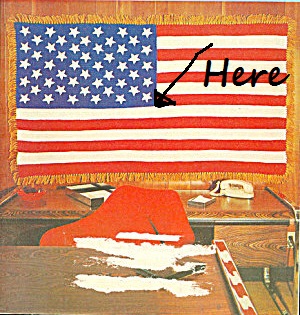
And just for fun I present this pattern for this crochet American Flag from the July 1974 edition of Workbasket. I typed out all the abbreviations and rewrote a few things to make the pattern more readable.

You all know you want that office. Don't lie, I know you do. 
American Flag
Yardage: You will need 20 ounces of white yarn, 16 ounces of red yarn, 12 ounces of blue yarn, and 4 ounces of gold yarn. All worsted weight.  (Nancy note: That's about 900 yards of white, about 760 yards of red, 570 yards of blue, and about 170 yards of gold. They're definitely using cheap scratchy acrylic for this so if you're going for historical accuracy go find some Red Heart value yarn.)
Gauge: 7 single crochet equal 2 inches
Hook: Size F

Work Begins on lower edge.
Base Row: Starting with red chain 218, single crochet in second chain from hook, single crochet in each chain across, chain 1, turn.
Pattern Row 1: Single crochet in each single crochet across. Chain one, turn.
Repeat Pattern Row until there are 11 rows of red. Fasten off (Nancy note: Fastening off is really up to you,  you can also carry the red yarn up the side as you go.)
Join white and work 11 pattern rows.
Continue Changing colors from red to white until 3 red stripes and 3 white stripes are completed.
Change to blue and single crochet across 109 stitches. Chain 1, turn.
Continue in blue until 77 rows are completed.
Join red in first single crochet after first blue row. (Nancy note: this might be a little confusing so I made a diagram.)


Work 11 rows of single crochet in red for first short stripe, fasten off.
With White, work 11 short stripe rows.
Work 4 red and 3 white short stripes.
Sew blue panal to edge of short stripes with small stiches. (Nancy note: Use whip stitch or blanket stitch.)

Stars: Make 50. With white chain 4, join into a ring with slip stitch.
Row 1: Chain 1, stitch 15 single crochet stitches inside ring, join to first single crochet stitch with slip stitch.
Row 2:* Chain 6, slip stitch in second chain from hook, single crochet in next chain, half double crochet in next chain, double crochet in next chain, treble crochet in next stitch, skip 2 single crochet, slip stitch in next single crochet, repeat from * around until you have 5 points. Join with slip stitch and fasten off leaving about 12 inches of tail to use to sew star on.
Sew stars on blue panel as shown in photograph (Nancy note: or like in any photograph of the flag), 6 in a row for 5 rows and 5 in a row for the 4 rows between them.

Fringe: With gold, cut strands about 6 1/4 inches long. Fold 3 strands in half and put them in every other single crochet around. Trim strands to even them out.

Tomorrow I bust out my Bicentennial magazines so stay tuned.

Thursday, December 16, 2010

The plot thickens?

For those of you who haven't been reading Tuesday's autochrome post's comments the Vintage Baroness and I have been debating over the time in which two of the Autochromes were created. Mrs. Baroness is a fabulous vintage dealer so I very highly respect her knowledge and opinions on the matter, but other than deciding that that one photo was very likely incorrectly dated we've still been pretty stumped.

I did manage to find out some information about the autochrome titled "Man and women carrying suitcases" by Charles C. Zoller. The catalog date on this photo is 1907 - 1932, but I'd like to narrow it down a little further.


My first thoughts were that this was a photo from the late teens or very early twenties. Based on the cut of the dress and the man's sweater/shirt combo. The Baroness suggested that this dress may in fact be an maternity dress and that the frame under the woman's hat looked like a 1930s horsehair type thing.

I became very excited at the thought of this lady's dress being a maternity dress because the thought had not even crossed my mind.It meant that this photo could very well be from the early 1930s, but I was still not convinced that this photo was from the late 20s/early 30s based on her lack of cosmetics. Of course not all ladies wore cosmetics, but with a color photo being such an expensive and time consuming process I highly doubted that a couple would spend the money on one and the lady would not bother to use some rouge.

Then the thought hit me that perhaps these people were friends or relations of Mr. Zoller's. So I went over to the George Eastman House online archives to do a bit of hunting. There are probably at least a hundred of Mr. Zoller's autochromes in the Eastman House collection and I knew that a good portion of them were online. Well, with a bit of luck I was able to find this photo of the same couple (with some unknown man on the porch) among a bunch of Mr. Zoller's personal photos.


The photo is titled "Couple leaving for honeymoon" and dated to the same time as the first photo. To me it is very likely that these people were part of Mr. Zoller's personal life, though I cannot say how. It's highly unlikely that this lady is wearing a maternity dress if they are leaving for their honeymoon so my first reaction was to go back to my original thought that this photo was snapped in the late teens. Of course than I noticed their shoes and now I'm not so sure of my original estimation.

The moral of this story is that I really have no idea when this photo was taken. I'm still trying to find the answer so if any of you have any wisdom you'd like to impart that might help me out here, please do so!

Tuesday, December 14, 2010

Autochromes!

So today is the day that I have been looking forward to for a loooooooooong time. Autochromes!

Anna Stocká by Josef Jindřich Šechtl ca 1909. This photo is the earliest known autochrome of Šechtl's. The lady in the photograph is his future wife Anna. This is my favorite autochrome of all time and it is currently in the collection of the Šechtl & Voseček Museum of Photography. I am especially fond of the soft pale blue color of her dress and her beautiful wide brimmed hat.  

I'll start with an explanation of what an autochrome is. An autochrome is a color photo printed on glass using potato starch. Crazy right? The process was invited by Auguste and Louis Lumière (the same Lumière brothers who invented the motion picture camera the cinématographe). The process was patented in 1903 and was used as late as the 1930s.

The process used a screen of tiny potato starch grains dyed orange-red, green and violet. The grains were dusted onto a glass plate and then covered with a layer of panchromatic silver bromide emulsion. As light entered the camera it was filtered by the dyed grains before it reached the emulsion. The exposure time for one of these images was very very long, but the result was a semi opaque positive color image on glass that required no further printing.

Close up of Autochrome approx 1911
While working at the George Eastman House International Museum of Photography and Film I was very fortunate to get to look at some autochromes up close. They need to be viewed on a light table to be seen properly, but I can tell you that the colors are even more vivid and stunning than the images in this post. It is very difficult to reproduce autochromes as digital files true to color because of the nature in which they are printed.

Autochromes are composed of a series of tri-colored dots (as you can see in the image above) that work like a video screen. Because the dots are so small and so closely packed together the colors of adjacent dots blend together in our eyes. Light from neighboring red and green dots will create a yellow color and like from violet and green dots will make a light blue. Neat, right?

I've included some of my favorite autochromes here, but I strongly encourage you to do a quick search online for others. It's amazing how well these images have held up over time and I just love getting to see the actual colors of frocks from the 1900s and teens!

Couple ca. 1910 by Mrs. Benjamin F. Russell. 
This lady is subscribing to a more relaxed fashion than the lady at the top of his post even though the photos were taken at relatively the same time. She's equally stunning in my opinion. I love the color of her frock, the simple cut, her matching pink scarf, and her cute hat. What do you think, Readers? Is that an engagement ring on her finger there?

Woman wearing red dress with houses in background ca. 1915.
 I find her up-do to be very lovely and her shoes to be very charming. It's a little hard to see but she is wearing a high lace collar and sleeves with lace cuffs. There are a ton of little button details up and down the front and sides of her dress that remind me of traveling coats from this era. I'm not sure what this frock is made out of, but the fabric is obviously quite thick and heavy. Canvas maybe? The way the fabric wrinkles around the skirt hem makes me lean more towards a heavy plant based fabric than an animal fabric.

Dancer wearing Egyptian-look costume with wings reaching to the floor ca. 1915
This would have been at the height of Egyptian fever, though still previous to the discovery of King Tutankhamun's tomb. As with most images from this period I could find out very little information about the woman in the photo and why she might be wearing this getup. Perhaps she is a dancer, though for what type of production I couldn't say.

Cowgirl by Mrs. Benjamin F. Russell  ca. 1910.
I love her! I love this image!  This autochrome is in the George Eastman House collection, Rochester, NY. I love her big hat and giant rodeo pants. I suspect this is more of a masquerade outfit or show outfit than actual work clothes, but I'm totally cool with that.

Lady Helen Vincent by Lionel de Rothschild ca 1910.
Lady Helen was apparently a society beauty and wife of the diplomat Sir Edgar Vincent. I am swooning over her beautiful pale pink dress with the lace sleeves. Just look at the lacy detail down the front of her skirt and the black belt around her waist is so classy.

Man and women carrying suitcases by Charles C. Zoller  ca 1907 - 1932.
I'm going to go ahead and guess that this print comes from 1918-1922 based on her dress and his sweater and tie. The only thing that keeps me from pinning this a few years later is the lack of make-up on her face. The early 1920s saw a huge swell in make-up usage with the widespread post-war availably of cosmetics. What do you think, Dear Readers? What time might this couple have lived in?


Unknown photographer, subject, and date... but wow. Just wow. Look at that dress! And look at those plumes on that hat! Look at that lace on her blouse! If this lady's attire doesn't scream fashion I don't know what does. Makes a girl want to start making Edwardian clothing doesn't it?

Seneca Pool 1924 ca. 1924
I really love these cute 1920s bathers. This pool was actually located not too far from where I went to college, but it has since been filled in. Look at how the ladies are mostly in dark wool swimsuits, but they wear brightly colored swim caps. I didn't realize that there were so many different cap color options when I wrote my 1920s swimsuit post. You learn something new every day. 

Monday, May 17, 2010

Lets talk Underwear!

Lets talk Underwear! 


No Really. Seriously and truly. As I've said before and I'll say it again, the first step to a great (not to mention authentic) vintage look is the foundation. Ever wonder why your vintage dress looks a little rumpled and puffs out where it's not supposed to? Having trouble getting that boxy 1920s look? Getting some rolls and muffin tops where you don't want them? If you're not wearing the proper foundation, that's your problem! 

So here's a very very brief (haha... brief) introduction to undergarments and more specifically shape. I borrowed almost all the undergarment images from Lara Corsets. You have got to check her out. She does some amazing work and has a fabulous collection of vintage corsets dating back to the 1700s. Really cool. 

Let's start with the 1910s. I know not many vintage fashionistas have vintage styled garments going back this far in time, but it's always nice to see the progression of style. I've tried to place a relevant pattern under each image of unmentionables so you can see how the undergarment determines the shape of the dress and not the other way around. 


This shape is achieved with corseting. Steel bones were most common until the beginning of world war I.. You can see that the corset is used to shape the body into a very unnatural shape. The hips are flattened, making the silhouette quite top heavy. The butt is also reduced giving the whole shape an off-balance forward leaning look. I would guess it was not easy to sit down in this type of undergarment. I've never worn one myself, but from wearing other long line corsets I'll just go ahead and say sitting was probably close to impossible and if you did manage to sit you weren't doing so comfortably.  


One WWI begins many women turn in their corsets to be used for metal for the war effort. The general shape of dresses and undergarments become much more natural (aka, less ridiculously smooshed). Corsets begin to shorten, hips are given a fuller shape. There's a short period where more emphasis is given to the waist than earlier in the decade. 


The 1920s arrive and dresses start to take on a much boxier shape. Boned corsets are thrown aside, hems are shortened, busts are bound! There's a real emphasis on a boxy look that de-emphasizes the overly cinched waist of the past century. Unboned shapers and girdles begin to be used to flatten out the whole body and give a nice smooth straight line under the garment. This is also the time of the mainstream appearance of the brassiere (not shown here) though it was little more than a camisole and offered no support. The 1920s brassieres worked the same as shapers, mainly serving to de-emphasize the breast and flatten the chest.


The 1930s are the dawn of the breast my friends. Woman are no longer flattening their chests and we see the introduction of cup sizes for brassieres. Breasts become more natural and curved. Brassieres are still very primitive and not very supportive. They do nothing to "push up" but rather they are used to "fill out" a woman's chest. The shape is a bit pointy compared to our modern standards.  Hips are still constricted with shapers, but the idea is to smooth rather than to reshape. Dresses still mostly have straight lines. The stomach down is still boxy. Undergarments keep this line flat.  From what I've seen one piece shapers and brassiere/waist down girdle combos seem to be equally popular, but the one piece shaper definitely gives you a cleaner line.


The 1940s give us better fitted bras and cups. The shape of breast becomes a little more pointy, but nothing near the bullet bra of the 1950s. In all honesty undergarments don't change much in this period. With a war on and fabric rationing in full effect I guess there wasn't as much room to experiment. Bra technology continues to improve, but at a slower pace than the decade before and after. Waist shapers are still used, but again mostly to smooth lines. By now the look for is natural feminine curves and a far cry from the forced shape look of 30 years prior. We really start to see more and more of the A line skirt and the idea of slimming the waist. 


The 1950s gives birth to a rise top the idea of lifting the "girls" up as high as possible. The bullet bra was born. Circular stitching around the cups formed the pointed shape. Not all bras were padded bullet bras. There were many styles with more rounded cups, but almost all still had the pointed 50s shape. Women are still wearing girdles and shapers. This is in a continued effort to smooth lines. However the overall shape of the 50s is all about curves. Curvy hips, well lifted bust, and a tiny waist. Va-va-voom. The bigger the better.


And the 1960s. Undergarments start going under some massive changes with the addition of Lycra and flexible underwire. Some bras at the time were actually coated with a layer of foam latex rubber. They held their shape well and could stand up on their own. They make for a very unique look let me tell you. As the 60s progress cups begin to soften out. The shape becomes rounder. The extremely pointed bullet bra falls out of fashion and the Girdles of the last twenty years start to disappear. They are replaced by power elastic foundation garments. Some of this is a result of the times. Bra burning comes through during the 60s and though not many women participate, the idea causes some big changes. By the end of the 1960s and early 1970s our modern undergarment shape has been mostly formed. The idea that clothing should fit the woman and not that the woman should fit in the clothing seems to be the general consensus. Viva la liberte!